Menu
Close



After those two nights, all that remained on the long table were faint red stains circling the bottoms of the glasses.
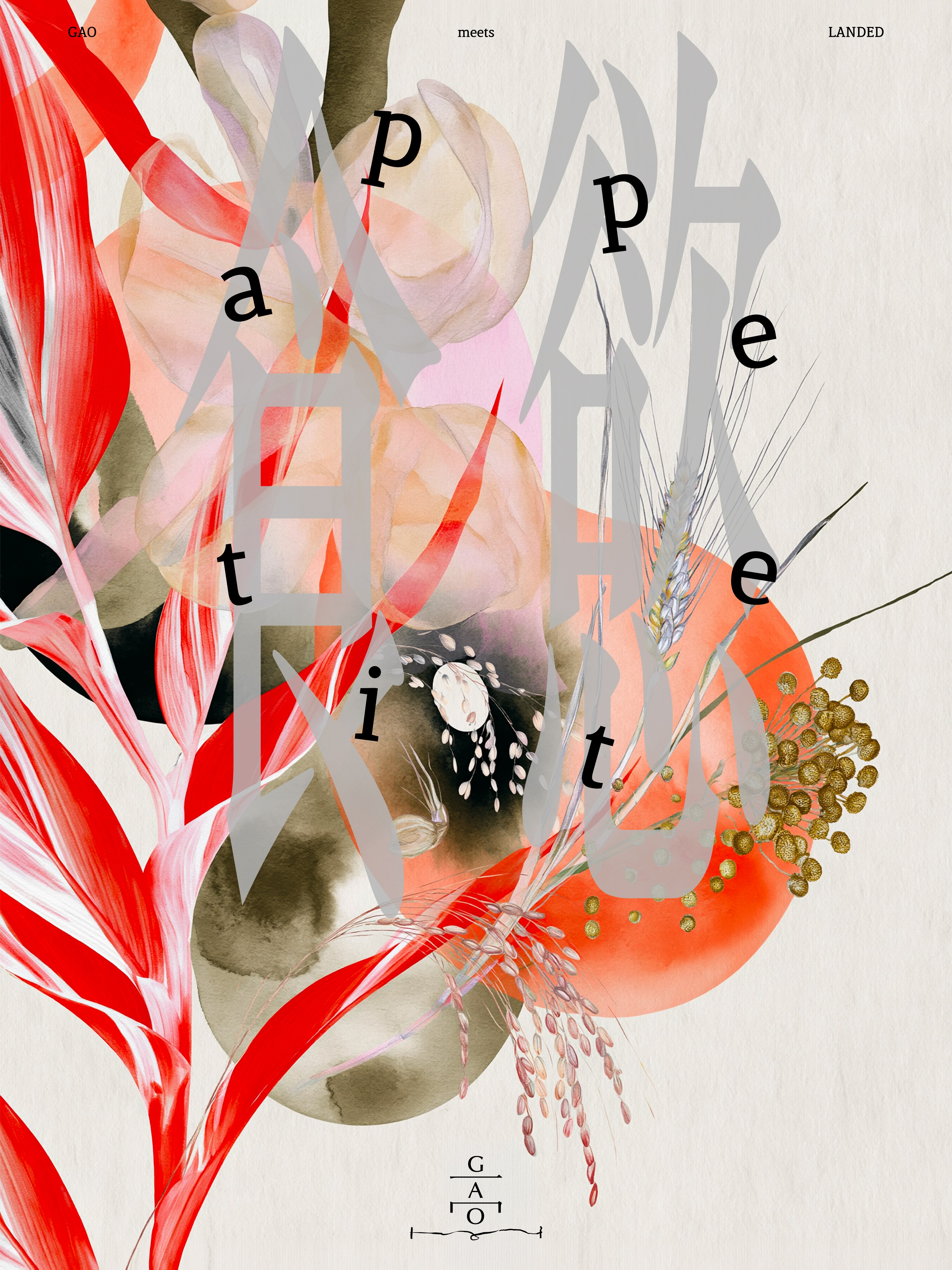
The core narrative of this tasting experience, co-curated by GAO and LANDED, stems from a short story: Lin King's Appetite. The piece won the PEN/Robert J. Dau Short Story Prize for Emerging Writers in 2018; within five thousand words, it chronicled the entire life of a Taiwanese woman.
GAO and LANDED initially noticed Lin King through her identity as a translator — she translated Yang Shuang-zi's Taiwan Travelogue into English, winning the National Book Award for Translated Literature in 2024. However, when deciding to use Appetite as the foundation of the event, what we saw was the metaphor within the story itself: a Taiwanese person translating a Taiwanese novel into the Anglophone world, while the very same person used English to write the life of a Taiwanese woman.
In Appetite, Wu Mei-ling is scrawny and pale as a child. Her mother took the salary originally meant for a nanny to hire a chef, issuing a strict mandate: stewed pork knuckles once a week, chicken soup twice a week. Those calories did not turn into flesh, but seeped into her bones — she shot up, growing taller than her mother, taller even than the burly chef.
Before she left for Taipei to study, her mother had the maid sew thick cotton pads into the lining of every dress she owned, attempting to smooth out her unyielding, angular edges. The year she graduated, she used her pocket money to buy a sleeveless dress that bared her arms, only to hide it at the very bottom of her suitcase.
The cotton pad is the heaviest hand her mother plays in the entire novel, and its intended action is to "smooth over."
Later, Mei-ling married, moved into downtown Taipei, gave birth to twins, and played the Carpenters at home. A Taiwanese woman playing American pop music in her own home, using a borrowed language to cover up the unspoken emptiness in her marriage — this shares the exact same essence as da chang bao xiao chang (Taiwanese sausage with sticky rice) being jokingly dubbed a "Taiwanese hot dog": both are acts of borrowing someone else's shape to tell one's own story.
She learned to play the guitar, the coarse strings vibrating beneath her fingertips, satiating her hunger. There was a subtle probing and suppression between her and her guitar teacher, yet it never culminated in a rupture or elopement. After the man left, only silence remained in the house. When her husband fell ill after retirement, she cared for him at his bedside, only to discover the betrayal he had hidden for years. There were no accusations, nor was there reconciliation.
Lin King once said she wanted to write about those seemingly gentle and placid women. Their outward behaviors are so uniformly consistent that it isn't until one grows up that one realizes there is a turbulent, hidden history beneath that facade.
This insight can be summed up in one English word: appetite. To translate it into Chinese requires two words, and neither is precise enough — 食慾 leans toward the mouth, while 慾望 leans toward the body. The original word simultaneously encompasses hunger, ambition, and those cravings yet to be named. The entirety of Appetite Night, from planning to execution, deals precisely with this untranslatable seam.

To address this seam, LANDED selected three wines.
The first is Malikuda Amis Beer, an experimental brew co-fermented with glutinous rice wine, grape wine, and malt juice. Three elements enter the same bottle, yet to converge into a fixed shape, perfectly corresponding to the sleeveless dress Mei-ling hid at the bottom of her suitcase — an appetite that hasn't yet learned to conceal itself.
The second is Domaine Daniel Bouland's Morgon. The scent of green leaves after a sudden afternoon thunderstorm floats on the surface, while mulberry, graphite, and smoke settle at the bottom. Lightness and richness coexist, interfering with neither.
It is worth mentioning a characteristic of natural wine here: it does not use inoculated commercial yeast; fermentation relies entirely on wild yeast naturally present on the grape skins, a process that cannot be fully controlled. This is exactly where LANDED sees its value — retaining that uncontrollable part, much like the very philosophy of translation.
The third is Weightstone's sparkling wine. Carrying fresh aromas of plum and grapefruit, it is sweet with a touch of saltiness, much like the indescribable aftertaste of one's twilight years. This is a wine rooted in the soil of Taiwan. The novel was written in English, but the story takes place in Taiwan; the liquid traveled in a circle, and ultimately returned to this island.
The accompanying savory dish is da chang bao xiao chang. The recipe originates from family memory: the mother would slice the pork sausage and glutinous rice intestine diagonally and pan-fry them. Here, it is transformed through a high-heat wok toss, adding pickled mustard greens, Thai basil, and a classic glaze. The sweet aroma lingers on the surface, while the sourness of the mustard greens and the profound depth of the wok hei serve as the foundation, walking the exact same gustatory line as the Morgon.

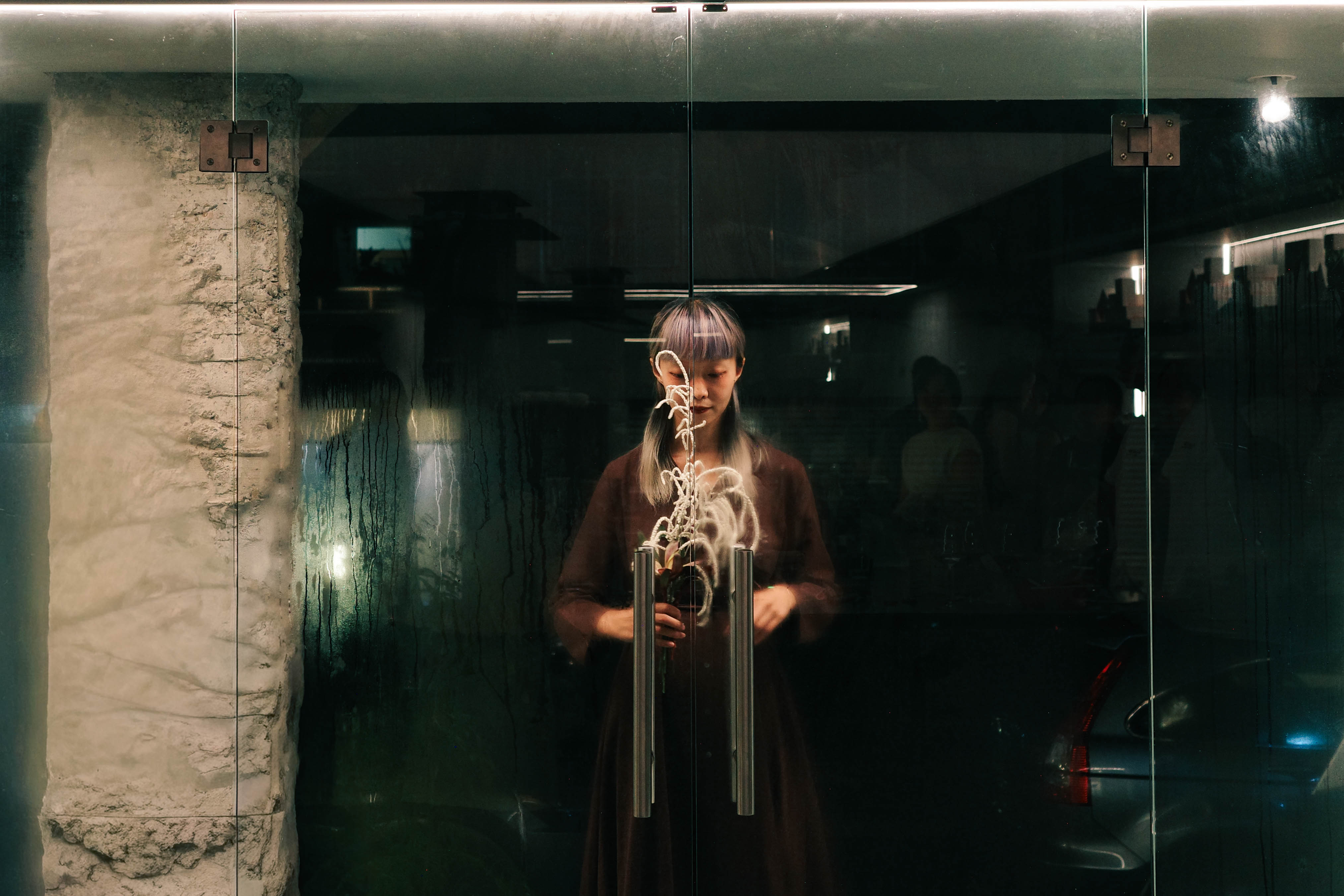
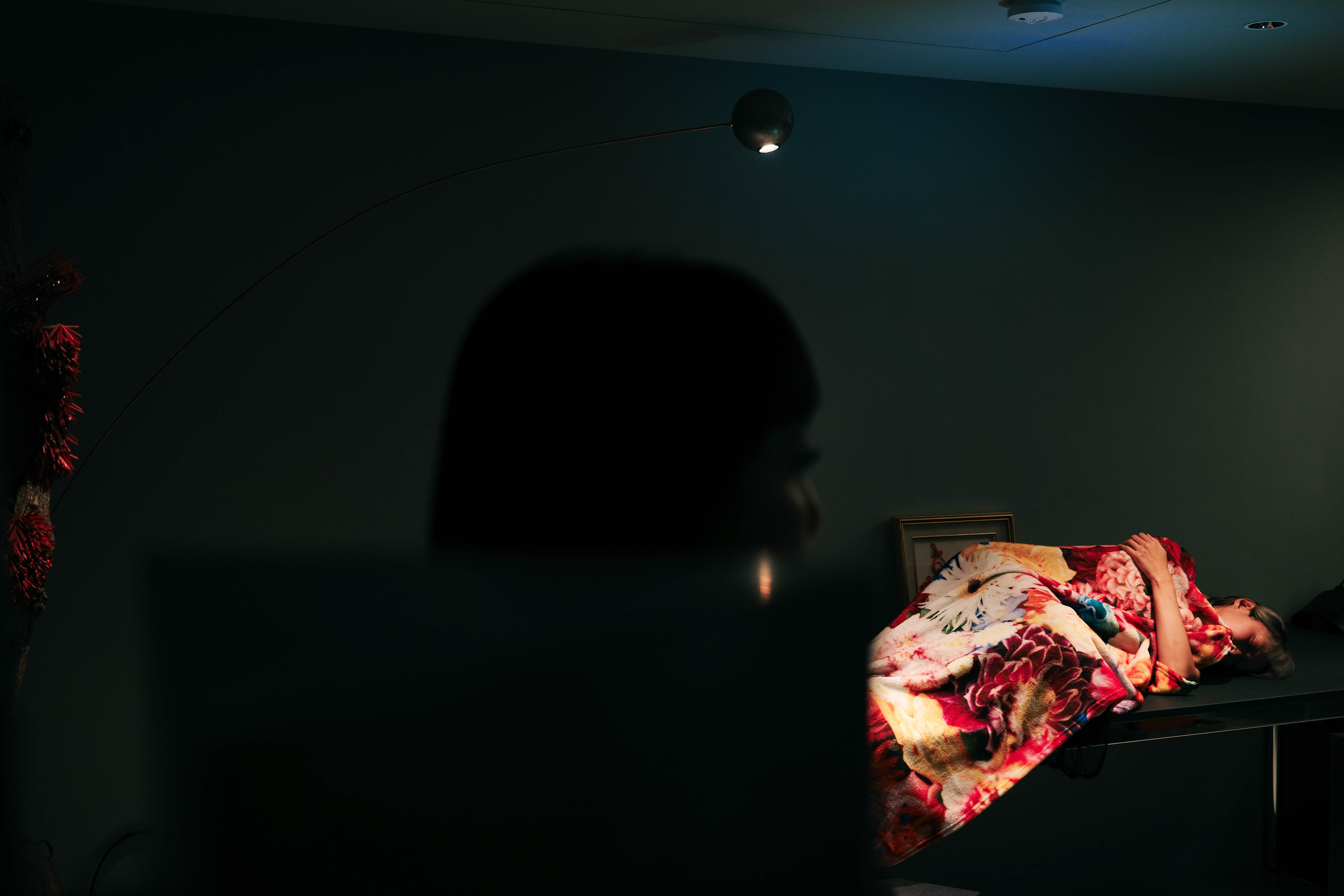
The second chapter is also the performance chapter of the night. Artist Mia Chen entered in the persona of Mei-ling. Her body was first placed into a specific posture, her muscles slowly accumulating tension in the stillness, before transitioning into a set of highly disciplined, everyday movements: serving, passing, receiving, retreating — precise almost to the point of being mechanical. Until, on one occasion, her hand stopped midway, pausing for half a second longer.
That half a second was the only time in the entire performance that truly belonged to her.
Much like the controversy sparked when the film industry cast a Black actress to play Helen of Troy, the woman in Appetite who imagines herself as someone else points to a core question: who has the right to possess which kind of imagination? This is never something that happens naturally.
In the past, Mia Chen created works of "pupation" by wrapping her body in silk fibers; on that night, she became the most literal translation of appetite — the desire to be sealed, slow-stewed, and tucked away in an unseen depth, until the very last few seconds when the seal is slightly loosened.
Simultaneously, Y.F Tamashi created soundscapes on the side. He started with a clean, rhythmic melody, and through constant repetition, allowed the music to breed noise, ruptures, and tape-like wear. On the surface, it remained the same loop, the same person, but the scars gradually emerged with every repetition. This was the auditory version of an "overly consistent exterior" being rewritten by time.
The final chapter was Weightstone sparkling wine paired with an ice cream cone, reconstructed from GAO's Sour Cheesecake. Guests had to choose between two flavor profiles: one was High Mountain Oolong tea, where the bitterness of the tea intertwined with the sharpness of the sour cheese, representing the quiet, introverted side; the other was Roselle and Perilla Plum, where the tartness and the sharpness of the plum spoke bluntly, representing the explicit, piercing side.
The novel did not give Mei-ling a definitive ending, so that night, the choice was handed over to the guests. The two flavors each corresponded to a different facet of desire — one tucked away into the mundane by time, the other floating to the surface. Over the two nights, the ratio of the two choices was surprisingly close.
In a moment where AI can generate any kind of tone, hosting such a physical, in-person event becomes all the more meaningful. A paragraph of text can be calculated, an accent can be imitated, but no one can "drink" a novel on behalf of someone else. That half-second pause, the wok hei of the pickled mustard greens, the exact spot where the bubbles prick the tongue — these sensations only happen within the physical body, not on a screen. Literature has never offered just information; behind language lies historical trajectories and collective memories. What this event did was provide a different entryway for it.
Appetite Night is the beginning of the collaboration between GAO and LANDED. In the future, we will continue with the same curatorial approach: select a literary work, select a few wines, and pair them with several flavors. Who the next piece will be about is yet to be decided, but the direction is already clear — those lives that have not been fully written.
The cone begins to melt in the hand. Some chose tea, some chose plum.
Desire has no name, but it is always there.
⚬ Dates: 2026.07.17 – 07.18 ⚬ Venue: 1F, No. 453, Fujin St., Songshan Dist., Taipei City ⚬ Text: Lin King, Appetite ⚬ Performance: Mia Chen・Y.F Tamashi ⚬ Wine Selection: LANDED.wine